%2Ffit-in%2F250x250%2Fguide_websites%2F6121%2Fimages%2F1782333116338image-2026-06-25t043142.079.png&w=1920&q=100)
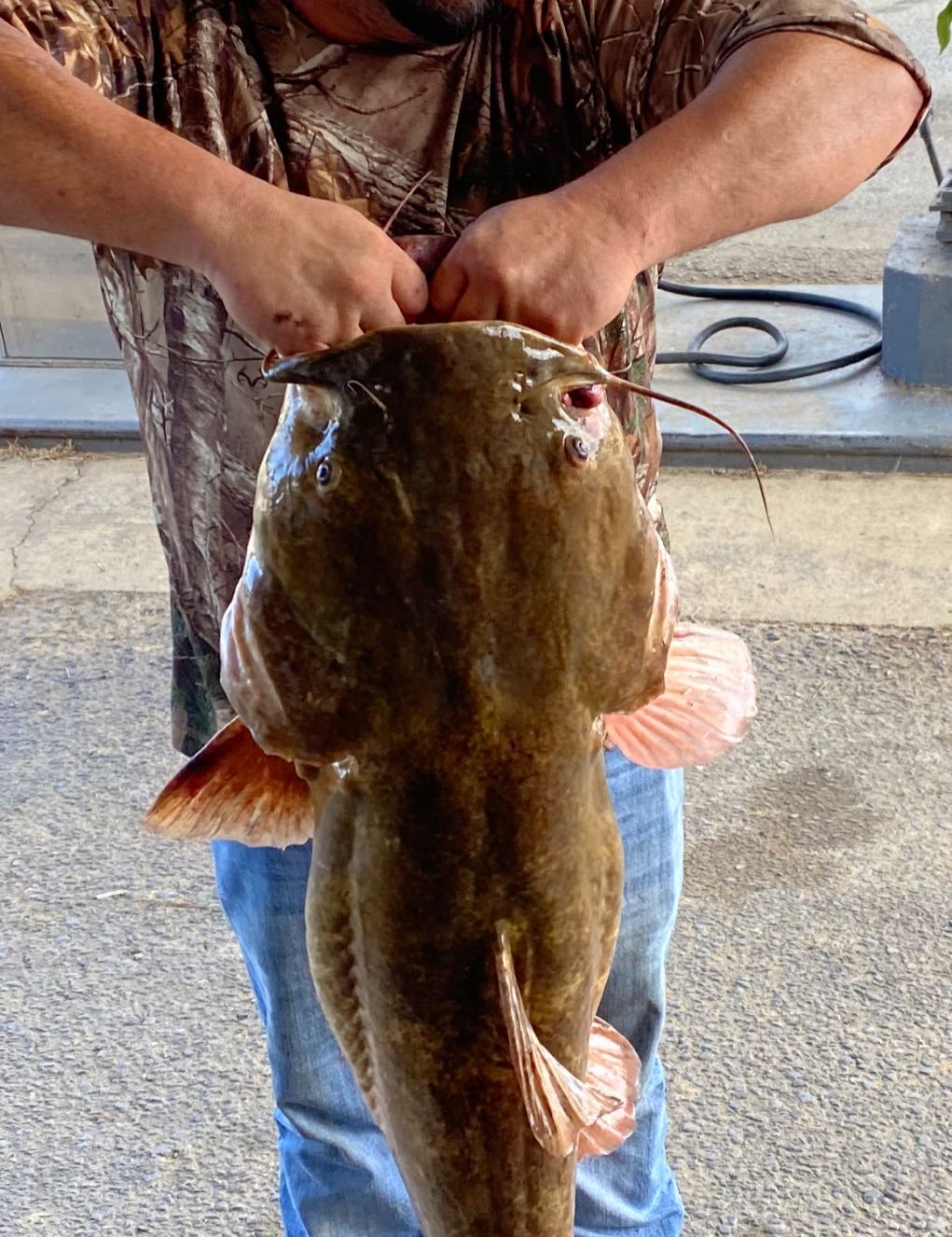
Longnose Gar Caught on Coosa River in Cave Spring GA
Longnose Gar Fishing in Cave Spring - What to Expect
%2F%2Fusers%2F1c5cd96b-aad0-496f-95ad-81bce376292b%2Fimages%2Fcave-spring-longnose-gar-fishing-2545.jpeg&w=1920&q=75)
Fishing Charter by Captain Homad Khandaghabadi in October
- Best Coosa River Fishing Charter


Summary
This fishing charter on the Coosa River in Cave Spring showcases a successful longnose gar catch, one of the most distinctive gamefish found in Georgia waters. Longnose gar are primitive predators known for their elongated snouts and powerful strikes, making them exciting targets for anglers seeking a unique freshwater challenge.
Fishing Charter with Captain Homad Khandaghabadi - Rates & Booking
Captain Homad Khandaghabadi of Coosa River Outfitters on Friday, October 9th offers specialized fishing charters targeting longnose gar and other Coosa River species. This guided fishing charter provides anglers of all experience levels the opportunity to connect with one of Georgia's most unique freshwater gamefish.
To book your Coosa River fishing charter or inquire about availability and rates, contact Coosa River Outfitters directly. The team specializes in personalized fishing experiences designed around target species and angler preferences.
Highlights of Your Coosa River Fishing Experience
The Coosa River near Cave Spring is a productive fishery known for its diverse gamefish populations and scenic natural surroundings. Longnose gar inhabit deeper pools and structure-rich areas where they hunt using their distinctive hunting strategy. Successful anglers learn to read water conditions, identify prime holding areas, and adapt techniques to match seasonal patterns.
Working with Captain Homad provides local expertise that translates to more productive time on the water. Understanding current flow, seasonal movements, and effective presentation methods significantly increases your chances of connecting with quality fish.
Local Species Insights: Longnose Gar
Longnose gar are among North America's most ancient freshwater fish, unchanged in appearance and behavior for millions of years. These elongated predators can exceed four feet in length and possess rows of sharp teeth designed for grasping slippery prey like baitfish and smaller gamefish. Unlike many fish species, longnose gar are air-breathers and frequently rise to the surface, making them visually exciting to pursue.
The Coosa River provides ideal habitat for longnose gar, with its mix of current breaks, deep pools, and abundant forage. These fish are ambush predators that position themselves along structure and wait for prey to pass within striking distance. Their elongated jaws allow them to strike sideways at targets, a hunting adaptation that makes them formidable predators in freshwater ecosystems.
Gar fishing requires patience and precise presentation. Traditional techniques include casting live baitfish near structure, drifting baits along deeper areas, and using specialized tackle that can withstand their powerful jaws and runs. When hooked, longnose gar are known for acrobatic jumps and strong head shakes, creating memorable battles that test both angler skill and equipment reliability.
The Coosa River's water conditions, seasonal temperatures, and seasonal prey availability all influence gar behavior and catchability. Spring and fall typically offer consistent action, while summer periods can concentrate fish in deeper, cooler sections. Captain Homad's local knowledge helps anglers understand these seasonal patterns and adjust strategies accordingly.
Beyond the fishing itself, pursuing longnose gar offers a connection to prehistoric predators that have survived largely unchanged for tens of millions of years. Understanding their ecology, behavior, and role in the river ecosystem deepens appreciation for freshwater conservation and the importance of maintaining healthy river systems.
Fishing in Coosa River: Longnose Gar
Longnose Gar Overview
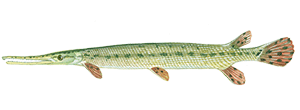
The Longnose Gar (Lepisosteus osseus) is one of North America's most distinctive freshwater gamefish, belonging to the ancient family Lepisosteidae within the order Lepisosteiformes. What makes this fish instantly recognizable is its dramatically elongated snout—sometimes called a "needlenose"—combined with its sleek, torpedo-shaped olive-green body covered in distinctive spots. Unlike their broader-snouted cousins the Alligator Gar, Longnose Gars feature a narrower, more refined snout that's perfectly designed for precision strikes on unsuspecting prey. If you've ever spotted one gliding silently through a river or marsh, you've witnessed one of nature's most effective ambush predators. These fish are highly valued by anglers for their incredible fighting ability and are found throughout freshwater systems across North America, making them a thrilling target whether you're fishing along coastal marshes or inland rivers.
What truly sets the Longnose Gar apart is not just its appearance but its behavior and physiology. These are primitive fish in the sense that their lineage stretches back millions of years with relatively few evolutionary changes—a testament to their success as a design. They possess a highly vascularized swim bladder that allows them to extract oxygen directly from the air, meaning they can survive in oxygen-poor waters where other fish would struggle. Their spiral valve intestines, inherited from ancient fish ancestors, continue to serve them well in processing their diet of smaller fish and the occasional crustacean.
Longnose Gar Habitat and Distribution
Longnose Gars are exclusively freshwater fish with a broad geographic range spanning much of eastern and central North America. You'll find them in streams, lakes, swamps, and the backwaters of major river systems where vegetation provides cover and smaller fish congregate. They show a remarkable tolerance for brackish water and have been documented in coastal areas where rivers meet the sea, though they prefer purely freshwater environments. Their distribution extends from the Great Lakes region down through the Mississippi River drainage and into the southeastern United States, with populations appearing in areas like Florida where they coexist with other predatory species.
These nocturnal hunters have a strong preference for vegetated areas, particularly during daylight hours when they remain largely inactive. At night, however, they become incredibly active, moving through shallow waters and along weed lines in search of prey. In rivers, look for them in slower current areas and deep pools where they can rest comfortably. Around marshes and swamps, they'll position themselves near dense vegetation where they can launch lightning-fast ambush attacks. The Longnose Gar's preference for nighttime activity is key to understanding where and when you're most likely to encounter them.
Longnose Gar Size and Weight
Typical adult Longnose Gars range from 28 to 48 inches in length, though specimens of up to 6 feet have been documented when left undisturbed in ideal conditions. The recorded maximum weight for a Longnose Gar stands at approximately 55 pounds, though most fish you'll encounter will weigh between 30 and 40 pounds. An interesting biological note: female Longnose Gars consistently grow larger than males, so if you're targeting trophy specimens, you're likely looking for a female. Their growth rate depends heavily on food availability and habitat quality, with fish in productive waters reaching maximum sizes faster than those in less fertile environments. Longnose Gars can live 15 to 20 years in the wild, with the oldest documented individual reaching an impressive 39 years of age, suggesting that a truly massive specimen might be decades old.
Longnose Gar Diet and Behavior
Longnose Gars are opportunistic carnivores with a diverse diet that adjusts based on their size and age. Younger fish primarily feed on small insects, crustaceans, and tiny fish species. As they mature, adult Longnose Gars transition to larger prey including sunfishes, bluegills, and other gamefish species. In regions like Florida, they're known to consume bullhead catfish, while in other areas they may ignore traditional gamefish entirely in favor of more abundant forage species. The key to their success is flexibility—they eat what's available and easy to catch.
The Longnose Gar's hunting strategy is pure ambush predation. Their torpedo-shaped body, powered by a strong tail, allows them to accelerate rapidly from a standstill position. Once they spot prey, they execute a lightning-fast sideways snap, using their long narrow snout and needle-sharp teeth to grasp and immobilize their catch between their jaws. This hunting style makes them nocturnal by nature, as they're most active when low light conditions allow them to approach prey undetected. During the day, they typically remain relatively inactive among aquatic vegetation, conserving energy for nighttime hunts.
Longnose Gar Spawning and Seasonal Activity
Longnose Gars spawn during late spring and early summer when water temperatures reach appropriate levels, typically in shallow, weedy areas of lakes, marshes, and slow-moving river sections. During spawning season, both males and females become more active and visible, often congregating in traditional spawning grounds that may be used year after year. The eggs are adhesive and attach to vegetation, where they develop until hatching. Interestingly, the eggs of Longnose Gars contain toxins and are poisonous to humans, so consumption should be strictly avoided—only the muscle tissue is edible.
Throughout the year, seasonal water temperatures influence Longnose Gar behavior significantly. In spring and fall, moderate temperatures keep them active throughout longer periods of the day. During hot summers, they tend to retreat to deeper, cooler waters and become primarily nocturnal. Winter activity decreases substantially, though they don't enter true hibernation and can still be caught during cold months in deeper pools and slow-moving sections of rivers.
Longnose Gar Techniques for Observation and Capture
Sight Fishing with Nylon Tails: The most effective and exciting method for targeting Longnose Gars is sight fishing using unbraided nylon tails rather than traditional hooks. Here's why: the Longnose Gar's mouth is too narrow for standard hooks to set properly, but the strands of unbraided nylon get tangled among their needle-like teeth, creating a mechanical connection that holds during the fight. Cast your nylon tail lure parallel to vegetation and weed lines, particularly during low-light conditions at dawn, dusk, or night. Let the lure run slowly along areas where you've spotted fish resting. The Longnose Gar's inherent opportunism means they'll strike at nearly any small moving object, especially when presented this way. Around areas like the Everglades or Mississippi River backwaters, this technique produces consistent results year-round.
Figure-Eight Retrieval: Named for its distinctive pattern, the Figure-Eight technique involves casting near suspected Longnose Gar locations and retrieving your lure in a serpentine, figure-eight pattern through the water column. This mimics the erratic movement of wounded baitfish and triggers aggressive strikes from ambush predators. Work the pattern slowly and deliberately, maintaining contact with vegetation and structure where these fish hide. This method is particularly effective during morning and evening hours when Longnose Gars are transitioning between rest and active feeding periods.
Bow Fishing (Culling and Management): In many regions, particularly where Longnose Gars are considered invasive or overpopulated, bow fishing has become an accepted management tool. This involves shooting fish at the surface using specialized fishing bows and arrows, typically during nighttime when fish are more active and visible. It's important to note that bow fishing results in the immediate death of the target fish—there's no catch-and-release option. This method is regulated differently in each state and should only be attempted where legal and appropriate.
Longnose Gar Culinary and Utilization Notes
The Longnose Gar occupies an unusual culinary niche—considered a delicacy in some cultures but rarely seen on restaurant menus due to several practical challenges. The muscle tissue of the Longnose Gar has a surprisingly tender texture similar to chicken but carries a more distinctive flavor often compared to alligator meat. However, processing is the real obstacle: their extremely tough, ganoid scales (the same type that gives them their armored appearance) are notoriously difficult to remove, making preparation labor-intensive compared to other fish species.
Critical warning: The eggs (roe) of Longnose Gars are toxic and should never be consumed under any circumstances. Only the white muscle tissue is safe for human consumption. If you do decide to keep a Longnose Gar for food, carefully fillet and skin the meat, discarding all roe and internal organs. In areas where Longnose Gars are plentiful, subsistence anglers and cultural communities have traditionally prepared them by smoking or slow-cooking the meat to make the tougher texture more palatable. From a sustainability perspective, culling populations through consumption can be beneficial in regions where they've become overly abundant.
Longnose Gar Frequently Asked Questions
Q: What is the best bait or lure for catching a Longnose Gar?
A: Unbraided nylon tails are your best option since traditional hooks won't work with their narrow mouths. Small shiners, mullet, or artificial lures that mimic baitfish also work well. The key is presenting something in motion that triggers their ambush instinct—they're not picky eaters when hungry.
Q: Where can I find Longnose Gar near major fishing destinations?
A: Longnose Gars are widespread throughout the Mississippi River system, Great Lakes tributaries, and southeastern freshwater bodies. Look for them in vegetated marsh areas, slow-moving river backwaters, and swampy lake sections. In Florida and Louisiana marshes, they're abundant year-round. Check with local fishing guides or state wildlife agencies for specific hot spots in your area.
Q: Is the Longnose Gar good to eat?
A: The meat can be eaten and is considered a delicacy by some, with texture similar to chicken and flavor comparable to alligator. However, preparation is difficult due to their tough scales. The eggs are poisonous and must never be consumed. If you keep one, fillet the white muscle meat carefully and discard all other parts.
Q: When is the best time to catch a Longnose Gar?
A: Longnose Gars are primarily nocturnal, making nighttime and low-light conditions (dawn and dusk) your best opportunities. They're most active during spring and fall when water temperatures are moderate. Summer heat drives them to deeper water and nocturnal-only feeding, while winter activity decreases significantly.
Q: How long do Longnose Gars live, and how big can they actually get?
A: In the wild, Longnose Gars typically live 15 to 20 years, though some individuals have reached 39 years old. Most adults range from 28 to 48 inches, but specimens up to 6 feet have been documented. The heaviest recorded individual weighed approximately 55 pounds. Female fish consistently grow larger than males.
Q: Are Longnose Gars native to North America?
A: Yes, Longnose Gars are native to North America and have inhabited freshwater systems throughout the continent for millions of years. They're considered a "living fossil" due to their primitive characteristics and unchanged body structure—a design that has proven remarkably successful for predatory hunting in freshwater environments.